Teaching Philosophy
On the first day of class, the students shuffle in with fear in their eyes; they have a preconceived notion of the class – difficult, stressful, and uninteresting. I believe this is because chemistry classes have a reputation of being taught in a dry, dull, and unapproachable way. I want to provide a great learning experience for my students through several goals: creating a comfortable and engaging learning environment, implementing active learning and innovative strategies to enhance student learning, and developing a relevant and intellectually stimulating education. I have strived to obtain a wealth of teaching experience by serving as an assistant and tutor in my undergraduate career and a lecturer and teaching fellow in graduate school. To provide the best learning experience for my students, it is important that my instruction reflects the passion and enthusiasm I have for both teaching and chemistry. As not all of my students will continue studying chemistry, an overarching goal for my students is to develop critical thinking and problem-solving skills so they are better prepared for life experiences.
Overall, I aim to focus my teaching on a growth mindset approach so that students feel comfortable making mistakes and learning from them. I hope to provide a positive environment and be an approachable, encouraging and enthusiastic instructor that inspires students to learn. I aspire to increase student engagement by utilizing biological and real-world examples, drawing connections between chemistry, their day-to-day experiences, and future careers. I want my teaching to expresses both my passion for teaching and learning and the enthusiasm I have for chemistry. By emphasizing understanding concepts over memorization, students will establish critical thinking skills which can be used throughout their lives. My goal is to increase student learning through active learning techniques, formative feedback, and diverse methods of concept explanation. Most importantly, I believe that the ability to influence young minds and shape the next generation is not only rewarding but requires dedication, adaptation, and innovation. As an evolving profession, it is imperative that educators are constantly learning from students, literature, and peers, allowing for growth and improvement.
Overall, I aim to focus my teaching on a growth mindset approach so that students feel comfortable making mistakes and learning from them. I hope to provide a positive environment and be an approachable, encouraging and enthusiastic instructor that inspires students to learn. I aspire to increase student engagement by utilizing biological and real-world examples, drawing connections between chemistry, their day-to-day experiences, and future careers. I want my teaching to expresses both my passion for teaching and learning and the enthusiasm I have for chemistry. By emphasizing understanding concepts over memorization, students will establish critical thinking skills which can be used throughout their lives. My goal is to increase student learning through active learning techniques, formative feedback, and diverse methods of concept explanation. Most importantly, I believe that the ability to influence young minds and shape the next generation is not only rewarding but requires dedication, adaptation, and innovation. As an evolving profession, it is imperative that educators are constantly learning from students, literature, and peers, allowing for growth and improvement.
Teaching Effectiveness
“Alexis was a phenomenal discussion leader. She took the time to cater to her students’ individual needs. She was enthusiastic, bright, and cheerful in her approach, assisting students in their entire thought process when approaching problems. She explained concepts well and tried many tactics in order to make sure students understood the material.” – Student quote from CH212 Evaluation (Spring 2012)
All of the discussion and laboratory sections that I have taught have been to undergraduate students. I have additionally designed and lectured a summer course for high school students. Graduate students in the department of chemistry serve as teaching fellows, requiring a workload of 20 hours a week. Boston University uses their own faculty feedback forms to evaluate teaching fellows. The Graduate School of Arts and Sciences accepts nominations for Outstanding Teaching Fellows written by their faculty advisor and selects a student to honor from each department. The Center for Teaching and Learning at Boston University selects applicants each year based on passion and effectiveness in teaching for a Scholar in Teaching and Learning Program. This program utilizes discussions to instruct future educators on teaching as research and pedagogical techniques to enhance student learning.
The courses that I have taught so far:
CH203 (Organic Chemistry I), CH218 (Integrated Science Experience II), CH174 (Principles of Organic Chemistry), CH174 Lab (Principles of 0rganic Chemistry Lab), Chemistry of Medicine Lecturer (Summer 2016-2018)
Teaching Assistant/Substitute Instructor:
(Fall 2013, Summer 2015) Organic Chemistry I
CH204 (Spring 2014, Summer 2015) Organic Chemistry II Laboratory
CH131 (Summer 2014) General Chemistry for Engineers
CH211 (Fall 2014) Intensive Organic Chemistry I
CH212 (Spring 2015, 2016, 2017) Intensive Organic Chemistry II
CH218 (Fall 2017) Integrated Science Experience II
All of the discussion and laboratory sections that I have taught have been to undergraduate students. I have additionally designed and lectured a summer course for high school students. Graduate students in the department of chemistry serve as teaching fellows, requiring a workload of 20 hours a week. Boston University uses their own faculty feedback forms to evaluate teaching fellows. The Graduate School of Arts and Sciences accepts nominations for Outstanding Teaching Fellows written by their faculty advisor and selects a student to honor from each department. The Center for Teaching and Learning at Boston University selects applicants each year based on passion and effectiveness in teaching for a Scholar in Teaching and Learning Program. This program utilizes discussions to instruct future educators on teaching as research and pedagogical techniques to enhance student learning.
The courses that I have taught so far:
CH203 (Organic Chemistry I), CH218 (Integrated Science Experience II), CH174 (Principles of Organic Chemistry), CH174 Lab (Principles of 0rganic Chemistry Lab), Chemistry of Medicine Lecturer (Summer 2016-2018)
Teaching Assistant/Substitute Instructor:
(Fall 2013, Summer 2015) Organic Chemistry I
CH204 (Spring 2014, Summer 2015) Organic Chemistry II Laboratory
CH131 (Summer 2014) General Chemistry for Engineers
CH211 (Fall 2014) Intensive Organic Chemistry I
CH212 (Spring 2015, 2016, 2017) Intensive Organic Chemistry II
CH218 (Fall 2017) Integrated Science Experience II
Activities to Improve Teaching
Professional Development in Teaching
- Chem Ed Supergroup (2020-Present)
- Managing the LfA Experience, Boston University (2020)
- Hands on Teaching Lightning Talk, Boston University (2020)
- Long Block & Large Lecture Classes Lighting Talk, Boston University (2020)
- Future Faculty Workshop (2020)
- STEM Inclusive Teaching Practices Webinar Series (April 2020-2020)
- Weekly Teaching Arts Luncheons (Smith College, 2019-2020)
- Sigma Xi Seminars (Smith College, 2019-2020)
- What the Best College Teachers Do Workshop (January 2019)
- Preparing for Finals Workshop (Boston University, November 2017)
- Leading Engaging Discussions Workshop (Boston University, October 2017)
- Teaching at Teaching Intensive Institutions (Westfield State, October 2017)
- Using Early Feedback to Inform Your Teaching Workshop (Boston University, September 2017)
- Graduate Student Teaching Day (Boston University, August 2017)
- An Introduction to Evidence-Based Undergraduate STEM Teaching (Boston University EdX Online Course, Summer 2017)
- Studied fundamental concepts and core practices of the Scholarship of Teaching and Learning examining the intersection of instruction and student learning
- Designed and completed a research project
- Discussed current active learning strategies and their application in the classroom
Contributions to Teaching Profession
|
Bringing interdisciplinary drug discovery research methods into the organic chemistry laboratory. A. Courtney, B. Benedictis, D. Sheehy, L, Pastorino, J.K. Snyder. Biennial Conference on Chemical Education in Notre Dame, IN. July 31, 2018, oral presentation
A. Courtney, A. Beeler. Pyrrole Synthesis in Flow: Bringing Flow Chemistry into the Organic Chemistry Laboratory, J. Flow Chem. (manuscript in submitted) |
Awards
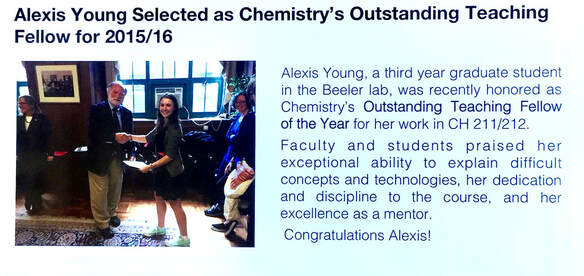
The Graduate School of Arts and Sciences 2015-2016 Outstanding Teaching Fellow in the Department of Chemistry